


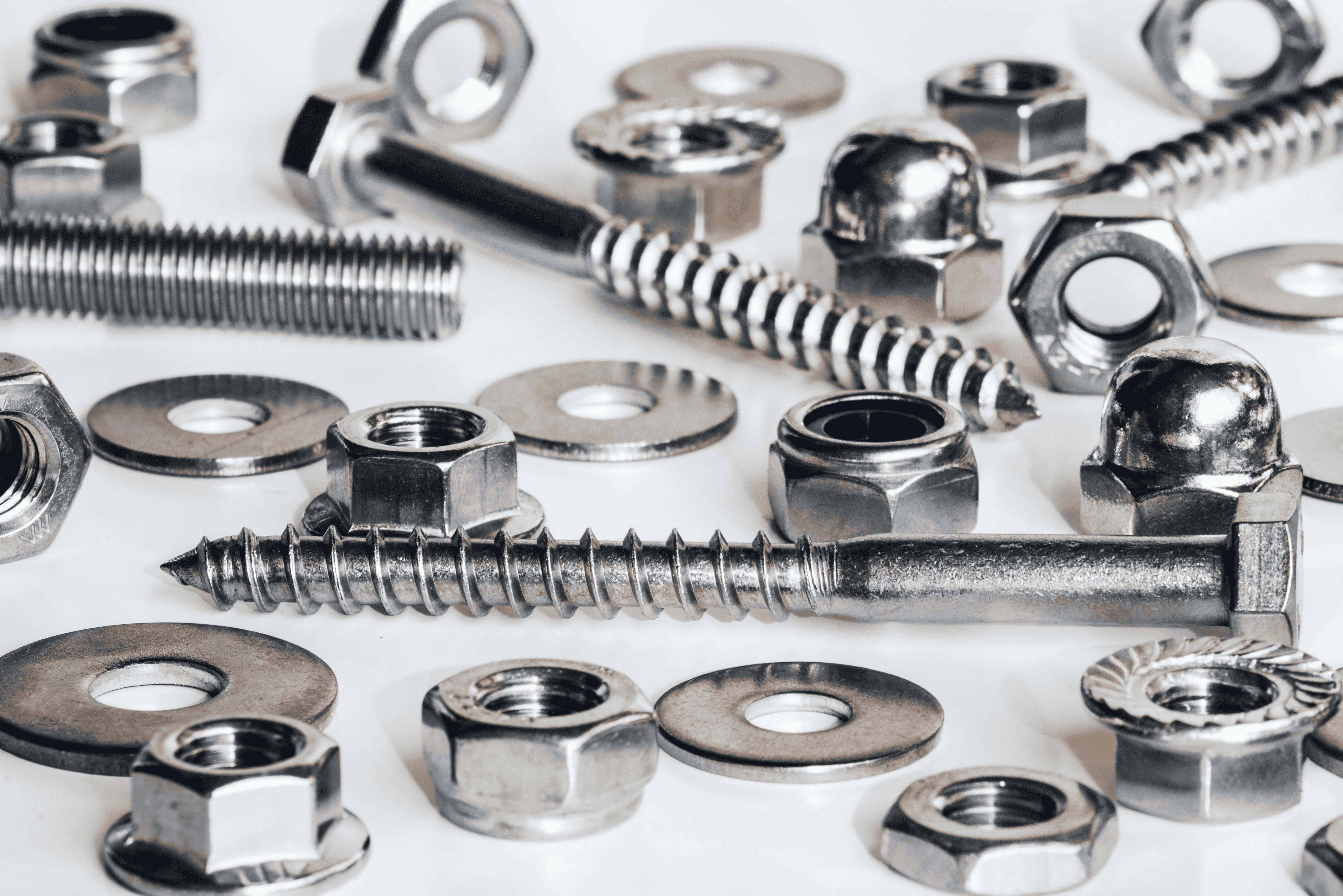
 Stainless steel fasteners are the go-to choice when corrosion resistance, hygiene, and long-term durability outweigh the need for lighter or more exotic materials. KD Fasteners, Inc.® is a full-service fastener supplier stocking stainless steel nuts, bolts, screws, and washers in the grades engineers specify for marine, food processing, medical, and architectural applications.
Why Choose Stainless Steel Fasteners?
Stainless steel earns its corrosion resistance from chromium, which forms a thin, self-healing oxide layer on the surface of the metal. That passive layer protects the base metal from rust and staining, and it regenerates on its own if the surface is scratched or machined — a property no coating or plating can replicate. Higher-alloyed grades add molybdenum and nickel to extend that resistance to chlorides, acids, and saltwater exposure.
Austenitic grades (the 300 series) are non-magnetic and offer low electrical and thermal conductivity, making them useful anywhere magnetic interference or heat transfer through the fastener is a concern. Martensitic grades like 410 and 416, by contrast, are magnetic and heat-treatable, trading some corrosion resistance for added strength and wear performance. Compared to aluminum or plated steel, stainless steel fasteners hold up longer in wet, chemical, or outdoor environments without the added step of coating or re-plating.
Stainless Steel Grades We Carry
KD Fasteners stocks stainless steel fasteners in a wide range of grades to match your application:
- 18-8 Stainless (300 Series): The most common stainless fastener grade, covering 302, 302HQ, 303, 304, and 305. Non-magnetic, corrosion-resistant, and suited to general-purpose industrial and commercial use.
- 316 Stainless: Adds molybdenum for greater resistance to pitting and chloride attack, making it the standard choice for marine hardware and saltwater exposure. 316L, a low-carbon version, offers improved weldability.
- 410 Stainless: A martensitic, heat-treatable grade that is magnetic and offers higher strength than 300-series grades, though with reduced corrosion resistance.
- 416 and 420 Stainless: Free-machining and higher-hardness martensitic grades used where wear resistance and machinability matter more than maximum corrosion protection.
- 321 and 347 Stainless: Stabilized grades that resist sensitization and maintain corrosion resistance after welding or exposure to high heat.
- Alloy 20: A nickel-iron-chromium alloy with added copper and molybdenum, specified for resistance to sulfuric acid and other aggressive chemicals.
- A2 and A4 (Metric Equivalents): A2 corresponds to 300-series stainless, and A4 corresponds to 316, giving international buyers a direct metric equivalent to standard inch-based grades.
We also supply ASTM A193 Class B8M fasteners for high-temperature and high-pressure bolting applications.
Common Stainless Steel Applications
Because stainless steel resists rust, chemical attack, and bacterial growth, it shows up across a wide range of demanding environments, including:
- Marine hardware and shipbuilding
- Food and beverage processing equipment
- Medical and pharmaceutical equipment
- Chemical processing and piping systems for oil and gas and industrial manufacturing
- Architectural and structural hardware
- Outdoor construction and infrastructure
Stainless Steel Fastener Types Available
Our stainless steel inventory includes hex cap screws, hex tap bolts, hex nuts,washers, nylon lock nuts, self-tapping screws, thread forming and thread cutting screws, machine screws, studs and threaded rods, socket products (cap screws, set screws, and shoulder bolts), self-drilling screws, lock washers, lag bolts, wing nuts, wood screws, rivets, thumb screws, cotter pins, carriage bolts, dowel pins, and slotted spring pins, along with tamper-proof drive styles including Snake Eyes™, Tri-Wing™, one-way, Phillips pin-in, Torx™ pin-in, and socket pin-in.
Standard, Metric, and Custom Stainless Steel Options
As a metric nuts and bolts supplier, we stock A2 and A4 metric grades alongside our standard inch-based inventory, so projects built to either standard are covered from a single source.
If your application calls for a less common grade or a size we don't stock, we can produce stainless steel fasteners to print, including 316L, 321, 347, Alloy 20, and other specialty grades made to your exact specification.
Frequently Asked Questions About Stainless Steel Fasteners
What is the difference between 304 and 316 stainless steel fasteners?
Both are austenitic, non-magnetic grades, but 316 contains added molybdenum, which gives it significantly better resistance to pitting and chloride corrosion. 304 performs well in general industrial and commercial use, while 316 is the preferred choice for marine environments and other applications with regular saltwater or chemical exposure.
Are stainless steel fasteners magnetic?
It depends on the grade. Austenitic 300-series grades like 304 and 316 are non-magnetic, though light magnetism can develop after cold working, such as forming or machining. Martensitic grades like 410, 416, and 420 are magnetic by nature and are typically specified when strength or wear resistance matters more than magnetic properties.
Why do stainless steel fasteners gall, and how can it be prevented?
Galling occurs when the threads of a stainless fastener generate friction-based heat and fuse to the mating threads, usually from overtightening or repeated cycling without lubrication. It's more common in stainless-to-stainless connections. Using an anti-seize lubricant, tightening at a controlled rate, and avoiding overtightening all reduce the risk of galling in stainless steel assemblies.